
Agents take cases off the queue. Failures go somewhere.
Assay is built so an agent session and a person can work the same run without stepping on each other, and so a failure is never just a red mark nobody follows up.
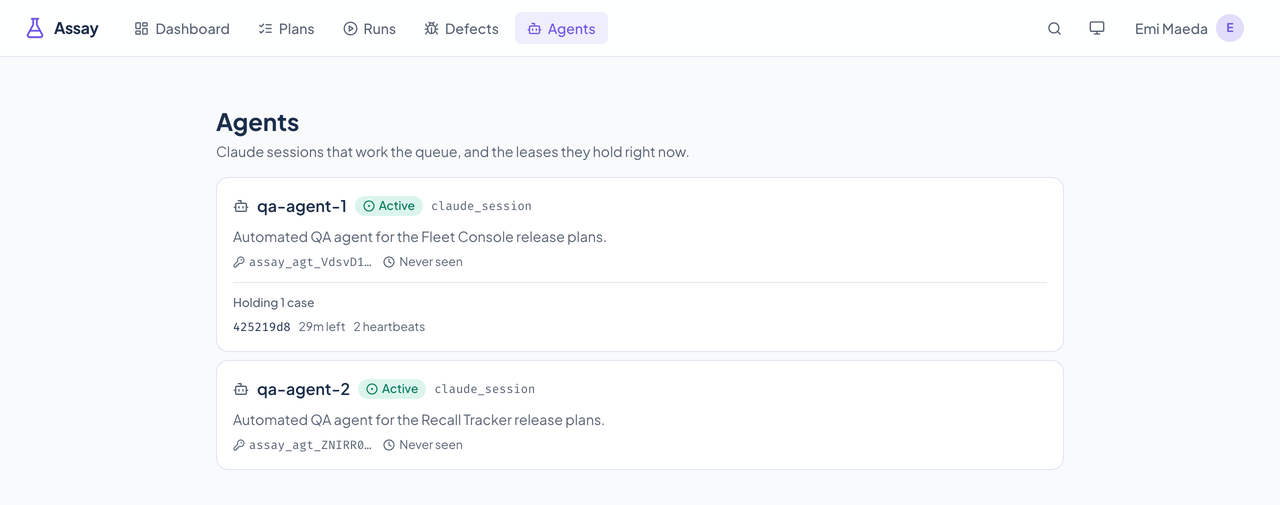
A claim is a lease, not a lock.
Cases are assigned to an agent first. The agent then claims them one at a time, highest priority first, with a single call.
Claim
The agent presents its key and asks for its next case. The database hands each case to exactly one caller, using row locks that skip rows another caller already holds, so two agents never get the same case.
Execute and report
The claim returns the steps, the run's environment settings, and the plan's environment notes, so the agent is never testing blind. It reports each step and the case result, and can attach evidence.
Heartbeat
A lease lasts 30 minutes by default. A heartbeat extends it, up to 4 hours from the first claim.
Release or expire
If the agent stops, a sweeper that runs every 30 seconds returns the case to the queue. The steps already reported stay recorded, and a case that keeps losing its claim is blocked with a reason.
| Scope | Lets an agent |
|---|---|
| Read | Read plans, runs, and cases. |
| Claim | Claim, heartbeat, and release its own assignments. |
| Report | Report step and case results. |
| Evidence | Attach evidence to a case or step. |
| Comment | Reserved for discussion on a case. Nothing uses it yet. |
An agent key can't author a plan, assign work, or administer anything, and a key can't act as a person.
File it, link it, or say why not.
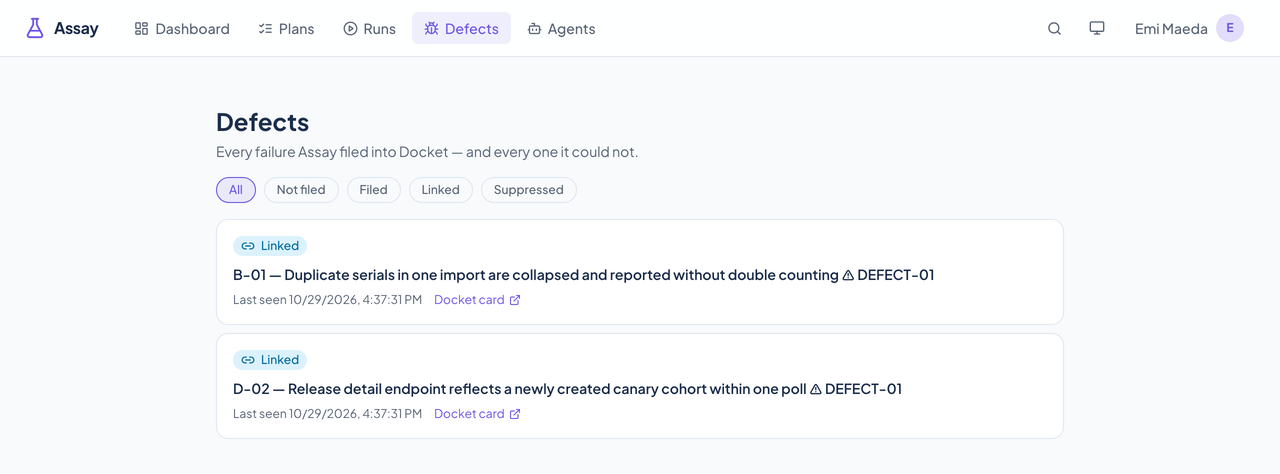
A failed case has four possible outcomes, and each one is recorded on the Defects page.
| State | Meaning |
|---|---|
| Filing | Queued; a worker is about to create or update the card. |
| Filed | A Docket card exists, created from the case's steps, expected and actual results, environment, and priority. |
| Not filed | Delivery failed. The failure is recorded, the error is shown, and the page leads with these. |
| Linked | The failure is attached to a card that already existed. |
| Suppressed | Deliberately not filed, with a reason on record. |
De-duplicated
Assay compares the first line of the failure text, with ids, timestamps, and long numbers masked. A repeat comments on the existing card and bumps its occurrence count instead of filing another.
Never inline
Filing goes through a durable outbox with retries that back off to ten minutes, so a Docket outage never blocks a tester's click or loses a result.
Redacted evidence
Secrets such as authorization headers, JWTs, payment-provider secret keys, cloud access keys, service tokens, and agent keys are replaced before evidence is stored, and the patterns that matched are recorded with it.
When a Chirp webhook is configured, Assay also posts a short notice when a run starts or finishes, when a P0 or P1 case fails, when a defect is filed, and when a run stalls.